
Understanding Small Kidney Tumors: What You Need to Know
This is a guest post by Reena Cherry, MS, PA-C of UC San Diego Health and a member of the Kidney Cancer Association’s Clinical Advisory Board.

When you hear the words “kidney mass”, “tumor”, “lesion”, or “growth” after a routine scan, it’s easy to feel alarmed. But not all kidney lesions are cancerous, especially if they are small.
What Is a Small Renal Mass?
A small renal mass is a growth or lesion on the kidney that’s usually about 4 cm (about 1.5 inches) or smaller. Many of these lesions are found incidentally — meaning they’re discovered when you get imaging (like a CT or MRI) for unrelated reasons like back pain or abdominal pain.
The good news? Not all of these masses are cancerous, and many don’t require immediate surgery.
Is It a Cyst or a Tumor?
The first question your care team will try to answer is whether the mass is a fluid-filled cyst (which is usually benign) or a solid tumor (which may need further evaluation).
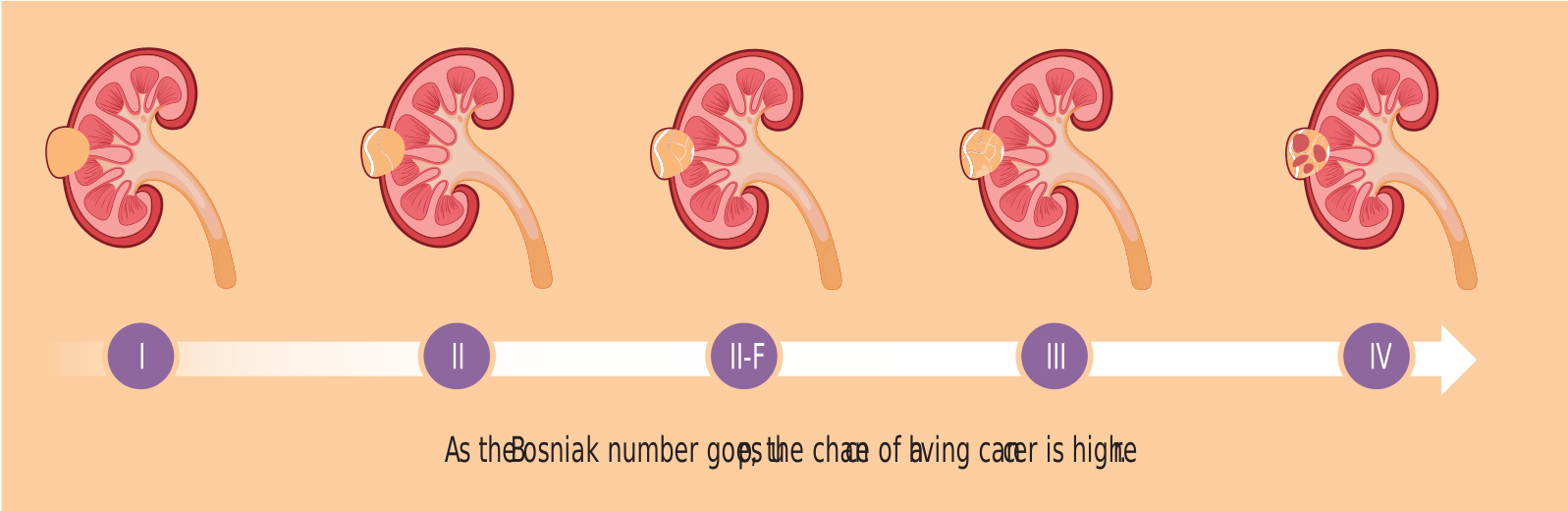
One important tool we use is the Bosniak Classification System, first developed in 1986 by Dr. Morton Bosniak. This system helps radiologists assess the risk that a kidney cyst might be cancerous based on how it appears on a CT or MRI scan. Below is a quick summary of the classification system:
- Bosniak I & II: Simple or mildly complex cysts — usually benign and need no follow-up.
- Bosniak IIF: A bit more complex — follow-up imaging is needed every 6–12 months.
- Bosniak III: Irregular cysts with concerning features – surgery recommended.
- Bosniak IV: These cysts are clearly cancerous as indicated by a solid, enhancing mass located inside the cyst. Surgery recommended.
Other Common Benign Kidney Lesions
Some non-cancerous (benign) tumors can mimic kidney cancer on scans. The two most common are angiomyolipomas and renal oncocytomas.
Angiomyolipomas are benign kidney tumors made up of fat, blood vessels, and smooth muscle tissue. They are often diagnosed based on imaging alone, as the presence of fat on a CT scan is a key indicator. Most AMLs are small and don’t cause problems.
Oncocytomas are another type of benign kidney tumor. They often appear as well-defined, solid masses that can enhance with contrast during imaging. These tumors grow slowly and typically do not spread. Oncocytomas can be difficult to distinguish from kidney cancer, even with imaging, so a biopsy may be necessary.
Understanding whether a kidney mass is benign or malignant (cancerous) often depends on subtle clues from imaging — and sometimes a biopsy or surgery is needed to know for sure.
How Are Kidney Masses Diagnosed?
Imaging is key:
– Ultrasound: Good for screening and checking if a mass is solid or cystic.
– CT Scan: The gold standard—quick, detailed, and effective.
– MRI: Useful when CT isn’t an option (e.g., allergies to contrast or poor kidney function).
In some cases, a biopsy may be done, especially if:
– You already have cancer elsewhere
– Surgery would be risky
– There’s concern for a rare tumor type
Do All Kidney Tumors Need Surgery?
Not always. In fact, for many people, the best approach is “active surveillance” or close monitoring with scans —especially if the mass is small (less than 3 cm), growing slowly, and not causing symptoms. If treatment of a small kidney mass is appropriate, the clinician will decide which method to pursue given the patient’s medical issues. Below are the main treatment options for small renal masses:
Active Surveillance:
– Imaging every 3–6 months
– Very low risk of spread (<1–2%)
– Ideal for patients with other health issues or limited life expectancy
Energy Ablation (Freezing or Burning the Tumor):
– Cryoablation: Freezes the tumor using ice
– Radiofrequency Ablation: Uses heat energy to kill concerning cells
– Less invasive than surgery, but may not be appropriate for all small lesions
Partial Nephrectomy (Surgery):
– Considered the gold standard for small tumors
– Removes just the tumor and immediately surrounding area, not the whole kidney
– Often done robotically
– Preserves kidney function better than full removal
What Should You Do Next?
If you or a loved one has been diagnosed with a small renal mass, don’t panic. Talk to your care team about:
– Whether imaging alone is enough
– If a biopsy is needed
– Whether you’re a candidate for active surveillance, energy ablation, or surgery
With modern imaging and careful monitoring, many kidney masses can be managed safely and effectively — without rushing into treatment.
Final Thoughts
Being told you have a “kidney mass” can be unsettling, but it’s important to know that not all masses are dangerous — and you have time to make an informed decision.
If you’re unsure, always feel empowered to seek a second opinion, ask questions, and explore all your options. Your peace of mind matters just as much as your health.
I was just diagnosed with a Lesion on my lt Kidney. It was found like you said due to me getting a CT scan of my abdomen for loss of appetite, extreme weight loss-unintended, fatigue, abdominal pain, nausea, and vomiting. I lost 40lbs in a month and a half. The Drs never told me a name, however , looking through my record they called it a focal renal lesion. Well now I just had to get a Renal Mass Protocol MRI and I’m scared out of mind. I’m doing all this research to figure it out. I’ve looked at a lot of articles but I’m not seeing any distinguishing symptoms associated with the Masses that are Cancerous aside from the ones that aren’t. In this article it was said they mimick each other. Can a tumor be Benign and you still have Loss of appetite and weight loss etc.,? Thanks
I have to have surgery to remove a kidney, will I be okay
I’m a kidney transplant patient who had scabs for something else and found 1.5 cm on my transplanted kidney. 5 years ago it showed up as 1 cm. Do I need an ablation done? I am 75 yrs old and otherwise in good health.
Now nearing age 72, about 12 years ago following a routine CT scan, I found out by accident that I have only one kidney.
The left kidney simply never developed, (renal agenesis).
After a recent MRI to address chronic lower back pain, an “irregularity” was spotted on my kidney.
I’ve had two melanomas removed surgically about 20 years ago and a facial basil cell electronically bombarded about 10 years ago.
Now, I am scheduled for a CT scan with contrast, (in a week), and a visit with my GP several days later to hopefully find out how serious this is.
No surprise, knowing that something potentially deadly is inside my body is profoundly disturbing.
Trying to occupy myself with other things isn’t easy, and the suspense is making me mostly nuts.
The doctor said i have a mass on my kidneys and I’m concerned
“ several T2 hyperintense masses in the right kidney measuring up to 1.3
cm in diameter consistent with cysts but not sensitively characterized on”
Discovered during lumbar MRI. I have an ultrasound scheduled for Monday. Have had some mild burning pain in the right abdomen. Anyone have several masses that are just cysts and is this anything to be concerned about?
How’s it going. Mine is 1.2 cm. Getting an mri dec 19.
For anyone concerned I have just had a partial nephrectomy to remove two tumours from my right kidney. I am extremely lucky that the tumours were found to be benign. You will be sore and very tired for a few weeks but it was the best decision I ever made. Good luck everyone and trust your surgeon.
They. Found a mass accidentally by doing a ultrasound is on my right kidney I have a MRI Jan 20,2026 but due not know if a biopsy is needed
Where do you find in N, NE ohio a radiologist who will classify a small kidney lesion 1.6cm, using the Bosniak scale through imaging?
They found a 3cm mass on my right kidney. They don’t know if it’s cancerous. I have consultation Friday 01/30 and then a scheduled biopsy. I’m not sure why it’s took a whole month for them to schedule me for a consultation and not a biopsy. Is beyond me . I’be been so stressed I just want to know already. I feel some pain on my right side sometimes but it’s not often. I’m eating better and I have a lot of energy cravings have not stopped.
KIDNEYS: A 1.6 cm cyst in lower pole of right kidney. No hydronephrosis. What does this mean??
I had an ultrasound yesterday for suspected gallbladder problem. My gallbladder isn’t good but they also found a 3cm lesion on my right kidney. Urgent scan first thing in the morning.
I have a cyst on right kidney. In size it’s 11.4 cm. Is that rather larger n size?
I was just diagnosed with a 1.9 cm indeterminate lesion on my right kidney. I am having an ultrasound on the 18th. Found on an incidental MRI of my lumbar spine and pelvis. Will the ultrasound tell me everything we need to know?
I’m having a scan on a benign kidney. I feel I’m better having it removed because the worry of it becoming cancerous is extremely stressful. Should I be so worried.
left side of kidney 2.1 cm for 8 years, almost no growing. how i need to do?
Maybe if you are looking for people here to donate, you should reply to their very real concerns.
I have prostate cancer and had a psmaPET/CT scan done and they found a 3.3 centimeter mass on my left kidney.
I’m scheduled for a partial nephretomy. Some interesting info on this site but could help people out by responding.
I’m NO DOCTOR but searching thru A.I. online can get you a lot of basic knowledge. The PET/CT scan is far better than any ultrasound or MRI if you are looking for answers. The imaging dye gets sucked up by the tumor if it is malignant so a biopsy isn’t as necessary (IMO). I’ve researched by Stage 2 prostate cancer as naseum only to discover this needs to be treated first.
Anyway, good luck to everyone! Get the PET scan with imaging and you get head to toe results (not everything I really want to see but…lol) and you can get a full body plan. I’ve changed my diet as well to build a better base for healing, hopefully, and you gotta keep moving every day!!! Walk, lift some weights, body weight exercises, …..anything helps. Trust me….because I haven’t been doing enough for a few years lol.
1.5 cm mixed density 60HU I have to do mri
In 2017 I had a CT and had a tumor on my right kidney. I was diagnosed with Renal Cell Carcinoma and had a partial nephrectomy. Just yesterday I was in the ER and had a CT and they found a 1.5 cm complex cyst on my left kidney. What are the chances this is the beginning of a reoccurrence? I’ve also had pain and unexplained weight loss. There is large amounts of blood in my urine.
Austin—I just had blood in my urine 3 months ago and an MRI spotted a 3cm mass in my rt. Kidney. The oncologist I was referred to stated that the blood is a definite sign of renal cell carcinoma.. My Dr. will see me in 6 months for a repeat MRI and to discuss possible biopsy or ablation
I also have stage 3 chronic kidney disease
Hope this helps. Good luck!
In 2024 a small solid tumor (1.4 cm) was found on my right kidney. I had no symptoms. I decided not to have a biopsy. Several doctors kept trying to persuade me to get a partial nephrectomy but after doing extensive research I decided on the cryoablation. The procedure only took a couple of hours and I was back to normal within 48 hrs. I do have to have MRI scans for the next 5 years, just to be sure there’s no reccurrence. Have a consultation with a radiologist. Know all of your options. Praying for you all!
I was diagnosed with 1.2 centimetre growth in right kidney two years ago. Getting regular scans but nothing has changed.My mother and her sister both died of renal cell cancer though. Should I refuse any more scans and seek help if I get any symptoms. I feel such a fool. A fuss about nothing.
I had a 2.2 cm mass on my left kidney on February 17th. Had cryoablation on that date. Had followup ct scan May 6th. It showed mass was now 3cm with rind formation. Went to surgeon who suggested I see urologist to discuss options. I don’t feel redoing cryoablation is worth doing again since it only ended up getting worse. I’m afraid that I might not get better. Anyone have any advice or similar situations?
My husband has One 2.2 cm , in the right Kidney it was found in March 03th the doctor said Just Watch it “ , in June will be the next TCC in order to know if he will get partial nephrectomy we are nervious
I have a 5.3 cm mass on my kidney which causes me pain every once in awhile, I want it removed and my Dr does not think it a good idea, how do I get a quick second opinion from another hospital district?
Why are these people not getting replies for their questions. Any response would be better than none at all. They just want something to easy their minds. Come on people, just a little help please.
I went in for an MRI of my lumbar spine in June. A 1.3cm “nodule” was spotted on my left kidney. I have another MRI with contrast scheduled in two days, to see if it’s fluid filled or a solid mass. Reading through all of your messages has helped my terminology. I’m still nervous though. Good luck everyone.
In December of 2022 , I had a total Nephrectomy of my left kidney .I had an ultra sound done on my abdomen and bladder to see how if I was emptying my bladder correctly. That’s when they found an 11 cm mass on my left kidney . My urologist / oncologist sent me for a CT with contrast which showed renal cell carcinoma. He scheduled me for an emergency surgery and ended up having to remove my entire left kidney along with the 11cm cancerous tumor. have fortunately been medically ok since the surgery thanks to my doctor . I also have 2 cyst on my right kidney , one is 4.8cm and the other is 3.5 cm . I am going to see him again for my 12 month follow up where , I suspect , he will be sending me for another CT scan to see if these 2 cysts have grown or if they are still benign or if there is any change in these cysts since last CT scan.
In December of 2022 , I had a total Nephrectomy of my left kidney .I had an ultra sound done on my abdomen and bladder to see how if I was emptying my bladder correctly. That’s when they found an 11 cm mass on my left kidney . My urologist / oncologist sent me for a CT with contrast which showed renal cell carcinoma. He scheduled me for an emergency surgery and ended up having to remove my entire left kidney along with the 11cm cancerous tumor. have fortunately been medically ok since the surgery thanks to my doctor . I also have 2 cyst on my right kidney , one is 4.8cm and the other is 3.5 cm . I am going to see him again for my 12 month follow up where , I suspect , he will be sending me for another CT scan to see if anything has changed .
I had back pain went to the ER and they did a CT scan, that’s when they found two cyst on my kidneys. Went to the VA and they did a ultrasound that’s when the found the mass on my right kidney, it is cancerous but it’s only 1,3 cm so small they said it wouldn’t spread so we do a MRI every 3 to 6 months
This is a helpful explanation for anyone who discovers a kidney mass during an imaging test and immediately worries about cancer. I especially appreciate the clarification that small renal masses are not always malignant and may not require immediate surgery. The distinction between cysts and solid tumors is also important, since imaging can provide valuable information about the nature of a lesion. The overview of the Bosniak Classification System makes the different categories easier to understand, particularly the need for follow-up with Bosniak IIF findings. Clear information like this can help patients have more informed conversations with their healthcare providers and better understand why additional imaging or treatment may be recommended.